Thursday, December 13, 2012

TRANSITS 2


Planets keep travelling through the zodiac constantly. They influence various natal points during their movement. These natal points are the natal positions of planets in any given chart. They also pass through various houses and project aspects to them. In this manner they influence the houses in a chart. Their relative positions from natal planets are also important to find out their effect in transit.
Each chart has its own characteristics. The ascendants and positions of planets differ from chart to chart. Planets in transit move through the same signs for each individual but they do not give similar results to each individual. There is another very important reason for the effect of transits differing from one individual to the next. The transit of major, sub and inter-period planets are most important in a chart. If the time of birth is correctly recorded and the Vimshottari dasa time frame is correctly drawn up then the analysis of transit of each of major-period planet, the sub-period planet, and the inter-period planet would indicate the same event.     
The transit of the major-period planet should be examined in the light of promise that it holds in the birth chart. An event can materialize in the transit of a major-period planet only if the major-period indicates it. The major-period of Saturn may indicate that the individual would go abroad during its major-period. We can then determine the span of time in which he would go abroad through analysis of movement of Saturn through the chart. If transit of Saturn shows the possibility of the person going abroad in a span of time but the major-period of Saturn in the chart does not hold out any such possibility then notwithstanding transit indications the individual will not travel abroad. Clearly, transits are totally subservient to the periods.   
A major-period is analysed with reference to the ascendant and natal positions of planets in the chart. The major-period planet should be related to the karaka (significator) for the concerned event, to the concerned house and the same number of house from the natal position of the karaka (significator). For example, a major-period will indicate birth of a child if the major-period planet is related to Jupiter, the fifth house and the fifth house from natal Jupiter.
A sub-period is studied with reference to the place occupied by the major-period planet. Taking the above illustration further, the sub-period will show birth of a child if the sub-period planet is related to Jupiter, the fifth house from the place occupied by the major-period planet and the fifth house from Jupiter. The only distinction between the major-period and sub-period is therefore the consideration of the relevant house. Whereas for the major-period we take the relevant house from the ascendant, for sub-period we take it from the natal position of the major-period planet. The other two elements remain unaltered.
An inter-period is studied with reference to the natal position of the sub-period planet. The inter-period will indicate birth of a child if the inter-period planet is related to the karaka (significator) Jupiter, the fifth house from the natal position of the sub-period planet and the fifth house from natal Jupiter.
This is the reason why the effect of the sub-period of a planet in the major-periods of different planets differs. Barring a handful of cases when the sub-period of a planet gives similar results in different major-periods, the effects of sub-periods of the same planet in different major-period are different. We can say the same thing for the effect if inter-period. 
 It would be highly unusual to find two persons undergoing the same set of major, sub, and inter-periods with identical charts. Parashar has clearly stated that the chart should be analysed keeping the background, age, and ability of the individual. Therefore even when the same three periods are running for two individuals it is highly unlikely that both would be eligible for identical results. A child of ten years cannot expect a child but a man of 25 years can be an expectant father!!
We will take up the transit of the major-period planet in the context of real life charts in the next instalment. 

Monday, December 3, 2012

TRANSITS 1


Analysis of a chart tells us the trends that would appear in the life of an individual. Whether a person would keep good health, he would have good education, he will marry well, he will have children, he will be prosperous, he will have good status in life, etc are questions that could be addressed through this analysis. This whets the appetite for more information. The consultant wishes to know the stages in life when these trends would manifest themselves over the years. Herein comes the use of Vimshottari dasa, transits and annual charts. Vimshottari dasa is a superb means to determine a span of time in which a happening could be predicted for an individual. Brihat Parashar Hora Shastra has given an array of dasas through which events in life could be fixed but many of these dasas are conditional. These dasas do not apply to all charts across the board. Some other dasas are difficult to apply. They need intricate calculations. Vimshottari dasa does not suffer from these drawbacks. It is easy to comprehend. It is easy to apply. Its results are consistently correct. These are the reasons why Maharshi Parasar himself has singled it out and has recommended it as the most appropriate one for our age. Vimshottari dasa gives us a span of time, usually of a few months, in which an event may occur. For closer approximation of time recourse is taken to annual chart and transits. An annual chart is the chart for a particular year. It depends on the movement of the Sun. A chart is drawn for the moment when the Sun reaches the exact location that it occupies in the birth chart and it is analysed for developments that are likely to happen in that year. The annual chart gives amazingly accurate results but it has to be read in conjunction with the birth chart. Events that are not indicated in the birth chart cannot happen even when the annual chart shows them. Transits are many a time taken in lieu of annual chart. Having determined the span of time for a particular happening in the life of an individual through Vimshottari dasa the astrologer takes up transits of planets in that span to determine the day when the event could happen. Transit therefore plays a great role in astrological analysis. It is an extremely useful tool and has been stated in many different ways. We need not get lost in the labyrinth of theory. We should stick to the methods that work and give results. The usefulness of any astrological concept lies in its applicability. An elegantly described concept is of no use if it does not work. There is a good number of such concepts but we need not be judgmental about them. Astrology need be a practical science and only those concepts should be propagated that work. This should be our sole criterion. In the next several instalments we will pursue the enquiry on these lines. To be continued......

I am shortly going to start a series on transits here in which through illustrations I will give practical tips for analysis of transit results. Transits are closely related to the dasas. The transit of dasa planets is of utmost importance and therein lies the key to correct transit predictions.

Wednesday, September 7, 2011

Why do transits not affect all similarly?

It appears that transits do not apply evenly to individuals having the same rashi. For example, Virgo rashi is undergoing seven and a half years of adverse Saturn transit. Some people of this rashi are experiencing the effects of transit of Saturn severely, some other appear to have escaped the wrath of Saturn altogether.
I shall be happy have comments on it from friends.
For consultations please visit mathurastroconsult.blogspot.com mathurastroconsult.blogspot.com

Friday, October 15, 2010

Ketu-III


Ketu is also a planet for mysticism. The twelfth house represents awakening into super-consciousness and moksha. It is the mind that awakens into the Divine Reality and understands that the mundane life is but an illusion. Hence a contact between the fourth and twelfth houses is an indication of super-consciousness. The twelfth house from Ketu and the fourth house from the Moon should likewise be related to confirm this initial finding.
We will consider the birth charts of Ma Amritanandmayi and Raman Maharshi. Both of them are spiritually highly evolved saints.
We will first examine Ma Amritanandmayi’s chart. She was born on September 27, 1953, at 0910 hours at Vallikunnu, India, 9n10, 76e31, time zone 0530 hours east of Greenwich. Rahu is in the fourth house in Uttar Asadha constellation of the Sun. The Sun occupies the twelfth house. The fourth house from the Moon is in Leo and the twelfth house from Ketu is in Gemini. The Sun and Mercury are associated in the twelfth house.
The birth data for Raman Maharshi is as follows: birth on December 30, 1879, at 0100 hour near Madurai, India, 9n50, 78e15, time zone 0530 hours. In Raman Maharshi’s chart the owner of the twelfth house is in the fourth. The fourth house from the Moon is in Virgo and the twelfth from Ketu is in Taurus. Mercury and Venus are associated in the third house from the ascendant.

Thursday, October 14, 2010

Ketu-II


The eighth house from the ascendant is the house of death, occult and the supra-mundane worlds. The fourth house is the house of the mind. When the two are related the mind of the individual is able to take cognizance of and interact with the phenomenon of the eighth house. Ketu is the planet governing these matters. Hence the eighth house from Ketu also represents these matters. The Moon is the planet signifying the mind. Therefore the fourth house from the Moon will also stand for the mind. When the two houses relate the mind is able to identify, distinguish, recognize and interact with the other worlds and their denizens.
Some people have psychic ability and they make use of these abilities to earn their livelihood. These are the professional psychics. Such persons have their tenth house closely related to the eighth.
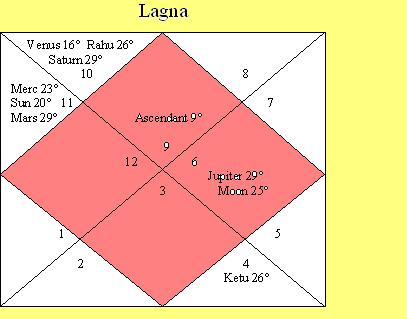
Saturn is the planet that governs profession. The tenth house from Saturn will also therefore show profession. The tenth house from Saturn therefore should be related to the eighth house from Ketu in such charts. The chart included in this post is one of a psychic who had taken it up as a profession. The individual was born on March 4, 1934 at 0318 hours at Saint Paul,MN,USA, 44n36,93w06, time zone 06 hours west of Greenwich.
Jupiter and the Moon are together in the tenth house. Jupiter is the owner of the fourth house and the Moon of the eighth. This shows a professional psychic.
Jupiter projects a very close aspect on Saturn. Jupiter owns the fourth house from the Moon. The eighth house from Ketu is in Aquarius. The tenth house from Saturn is in Libra. Venus and Saturn are together under aspect of Jupiter confirming the fact.