Friday, October 15, 2010

Ketu-III


Ketu is also a planet for mysticism. The twelfth house represents awakening into super-consciousness and moksha. It is the mind that awakens into the Divine Reality and understands that the mundane life is but an illusion. Hence a contact between the fourth and twelfth houses is an indication of super-consciousness. The twelfth house from Ketu and the fourth house from the Moon should likewise be related to confirm this initial finding.
We will consider the birth charts of Ma Amritanandmayi and Raman Maharshi. Both of them are spiritually highly evolved saints.
We will first examine Ma Amritanandmayi’s chart. She was born on September 27, 1953, at 0910 hours at Vallikunnu, India, 9n10, 76e31, time zone 0530 hours east of Greenwich. Rahu is in the fourth house in Uttar Asadha constellation of the Sun. The Sun occupies the twelfth house. The fourth house from the Moon is in Leo and the twelfth house from Ketu is in Gemini. The Sun and Mercury are associated in the twelfth house.
The birth data for Raman Maharshi is as follows: birth on December 30, 1879, at 0100 hour near Madurai, India, 9n50, 78e15, time zone 0530 hours. In Raman Maharshi’s chart the owner of the twelfth house is in the fourth. The fourth house from the Moon is in Virgo and the twelfth from Ketu is in Taurus. Mercury and Venus are associated in the third house from the ascendant.

Thursday, October 14, 2010

Ketu-II


The eighth house from the ascendant is the house of death, occult and the supra-mundane worlds. The fourth house is the house of the mind. When the two are related the mind of the individual is able to take cognizance of and interact with the phenomenon of the eighth house. Ketu is the planet governing these matters. Hence the eighth house from Ketu also represents these matters. The Moon is the planet signifying the mind. Therefore the fourth house from the Moon will also stand for the mind. When the two houses relate the mind is able to identify, distinguish, recognize and interact with the other worlds and their denizens.
Some people have psychic ability and they make use of these abilities to earn their livelihood. These are the professional psychics. Such persons have their tenth house closely related to the eighth.
Saturn is the planet that governs profession. The tenth house from Saturn will also therefore show profession. The tenth house from Saturn therefore should be related to the eighth house from Ketu in such charts. The chart included in this post is one of a psychic who had taken it up as a profession. The individual was born on March 4, 1934 at 0318 hours at Saint Paul,MN,USA, 44n36,93w06, time zone 06 hours west of Greenwich.
Jupiter and the Moon are together in the tenth house. Jupiter is the owner of the fourth house and the Moon of the eighth. This shows a professional psychic.
Jupiter projects a very close aspect on Saturn. Jupiter owns the fourth house from the Moon. The eighth house from Ketu is in Aquarius. The tenth house from Saturn is in Libra. Venus and Saturn are together under aspect of Jupiter confirming the fact.

Ketu-I


Ketu is a planet of mysterious functioning. It causes weird developments and growth. It gives rise to most unusual defects. It governs astral entities and is capable of causing trouble through them. It has the ability to confer supernatural powers, to induce development of extra-sensory perceptions and to promote appearance of psychic powers in an individual. Ketu is a prime principle of mysticism. It gives rise to saints and mystics.
When we study an aspect of life from a house from the ascendant, we should also, according to Brihat Parashar Hora Shastra examine the same number of house from the karaka for the aspect. Reference is invited to the Chapter entitled Karakatwas of Grahas. The principle is that if we study children in a birth chart, we should not only study the fifth house from the ascendant, we should also study the fifth house from the natal position of Jupiter.
The sixth house from the ascendant stands for defects. The sixth house from natal Ketu will stand for weird defects. The ascendant represents the physical form of a person. Sun governs this form. The first house from the natal position of the Sun will also therefore represent the human form. When the ascendant is related to the sixth house from it, the human form will have some defects. When the natal position of the Sun is related to the sixth house from natal Ketu the human form will have some weird defect. This is the birth chart of Simone Baker.
She was born with shortened arms, each with three-fingered hands beginning at the elbows. She was one of the last Thalidomide babies. The birth data is as follows:
27 Sept 1962, 0010 hour, Reading, England, 51n28, 0w59, Time zone 1hour East. The Sidereal ascendant is at 27°02’44” in Gemini.
The owner of the sixth house is Mars. It is placed in the ascendant and is in close sambandha with Mercury that owns the ascendant. The sixth house from Ketu is again the ascendant. The owner of the natal position of the Sun is Mercury which is in close relationship with Mars as we have seen.

Sunday, April 18, 2010

The Play of Planets

Events in life take shape according to the houses that relate to each other. For example, when the first and sixth houses are related through transiting planets the individual falls sick, meets with an accident, undergoes surgery or enters into a dispute; when the tenth house relates to the ascendant the individual gets a job, attains a position of authority or gets involved with the affairs of the office; when the fifth house gets related to the ascendant, a child is born to the individual, he meets with his children, he has happiness through children, etc. and when the fourth house relates to the twelfth, the individual goes away from home or changes residence. The exact nature of the event would depend on the karaka operating in this combination.
The question is whether the houses should be determined from the ascendant, from the Moon or from the natal place of the major-period planet. In my experience, the most accurate results are seen when the houses are taken from the natal position of the major-period planet. The second best results can be gleaned through the use of houses taken from the ascendant. The position of the Moon does not really appear in my scheme of things.
But does the mere relationship developing between houses cause events to take place? Herein comes the role of the major-period planet. When we consider relationship between houses taken from the natal position of the major-period planet developing through transiting planets such relationships point to certain events but these events will not materialise till the relationship also involves the major-period planet. Let us suppose planets in transit relate the fifth house from the natal position of the major-period planet to the first house. Would matters relating to children materialise through this transit. It may not happen unless while this relationship remains the major-period planet also relates to one or the other planet that causes the relationship between the two houses.

In the above chart this female went abroad and met her boy friend there on 26 July 2000. She was running the major-period of Venus. The fifth house shows romance and boy friend. The fifth house should relate to the first to bring about a meeting of the two. The fifth house from Venus is in Capricorn. The first house in the major-period of Venus will be Virgo. Saturn in transit, as is seen from the chart, is in sambandha with Venus. Venus is in Aslesha constellation of Mercury. Further, Mercury is in Ardra constellation of Rahu which is associated with Venus in the transit. We notice that Mercury and Saturn are closely related to each other and the major-period planet is an integral part of this combination.
Further, the ninth house from the natal place of the major-period planet should relate to the first house for the individual to travel abroad. Rahu should also figure in this combination as Rahu is the significator for journey abroad. The owner of the ninth house from the major-period planet is Venus which is in close relationship with Mercury, the owner of the first house. Rahu and Venus are together in the transit.Mercury is in a constellation of Rahu.

Saturday, February 27, 2010

Transits taken from the ascendant

We will now study transits taken from the ascendant. Whenever an event is to happen the concerned houses get related and we find the involvement of the concerned karaka also. If the individual is going to have a child the ascendant and the fifth house get related and Jupiter is also found involved in this combination; if the individual is going to fall sick the ascendant and the sixth house relate to each other and Saturn is found involved in the combination; and in place of Saturn if Mars is involved in the combination of the ascendant and the sixth house, the individual is likely to meet with an accident or undergo a surgery.
Let us take up two illustrations. The individual of the chart was born on 02 August 1951 at 2325 hours at 28 degrees North 39 minutes latitude and 77 degrees East 13 minutes longitude. The place of birth is 0530 hours east of GMT. The ascendant is in Aries and the fifth house has Leo. She had a son born to her on 2 November 1991. The major-period of Venus was going on. On the day of birth of the child the Sun was in exchange of sign with Venus in Libra, Venus being in Leo, and Mars was associated with the Sun. Jupiter on that day was in Leo with Venus.

Let us take up a case of an accident. This woman was born on 10 April 1979 at 0315 hours at 47 degrees North 42 minutes latitude and 122 degrees West 54 minutes longitude. The place of birth is 0800 hours west of GMT. She had gone to another country where she met with a vehicular accident on 16 March 2003. She was experiencing the major-period of Rahu at that time. The ascendant has Capricorn and the sixth house is in Gemini. On the date of the accident Saturn was in Taurus with Rahu and Mercury was in Aquarius. Saturn and Mercury were thus in sambandha. Saturn was in Mrigsheersha constellation of Mars. Further, Mercury was in Poorvabhadrapada constellation of Jupiter, and the latter was in sambandha with Mars on the day of the accident.
Events take shape according to the operation of the houses and karakas. We will give some more illustrations in the next blog.

Monday, January 18, 2010

Transit of the major-period planet

We now study a new method of transit analysis. This is a very effective method.
The transit of the major-period planet gives results very clearly. With a little practice results can be deduced with comparative ease. The effect of transit is dependent on the following factors:
(i) The contact of the transiting major-period planet with a karaka. This contact can either be with the natal karaka or it can be with that very karaka in transit.
(ii) The major-period planet in transit brings about a contact between two houses taken from the ascendant. The karaka mentioned above has to be relevant to the contact between the houses. Suppose there is a contact established between the first and the ninth houses. This gives rise to the possibility of a journey abroad, but the karaka for such a journey, Rahu, must at the same time be in contact with the major-period planet. If there is no such contact between the two planets, or if the major-period planet contacts some other planet and not Rahu, then journey abroad will not materialize.
Let us consider a live chart to clarify this concept. This is the chart of a male individual who was born on 10 August 1960 at 0810 hours at Rajpura (30ON29’, 76OE36’) in Punjab, India. The time differential between Indian Standard Time and GMT is 0530 hours East.
The ascendant is at 23O50’ in Leo. Sun (Cancer), Moon (Pisces), Mars (Taurus), Mercury (Cancer), Jupiter (Sagittarius), Venus (Leo), Saturn (Sagittarius), Rahu (Leo).
The individual met with a vehicular accident on 18 December 2008. He was in the major-period of Venus.
Venus was in Capricorn in transit on the date of accident associated with Jupiter and Rahu. Its dispositor was in Leo in the ascendant. Thus a contact is established between the sixth house (accident) and the ascendant that signifies the physical body of the individual. Natal Mars is in sambandha with natal Venus. Saturn is passing over this Venus. Hence Mars the karaka for accident is involved in this affair. We can go into more and finer details but limiting ourselves to the barest minimum the event is still clearly discernible.

Sunday, January 10, 2010

An Illustration of Transit Analysis

Female, DOB 5 January 1969, 11:45 am, Provins, France
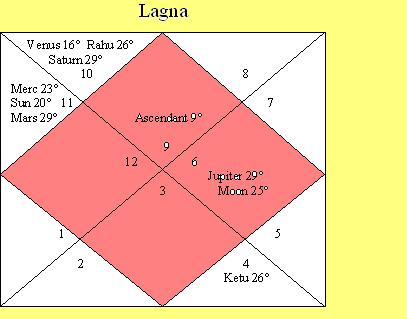
This individual has Pisces in the ascendant at 5 deg 17 min with Rahu and Saturn. Moon is in Cancer in the fifth house, Ketu and Jupiter in the seventh, Mars in the eighth, Sun in the tenth, Mercury in the eleventh and Venus in the twelfth.
The sub-period of Rahu is operating in the major-period of Venus.
The question is how to determine the transit effects of Rahu.
The first issue is to determine the houses that a Node would influence. There is a difference of opinion on the houses that a Node projects an aspect to. Some say the aspects are on the 2, 5, 7, 9, and 12 houses from the place of the Node; others say that it is only on the 5, 9, and 12 and so on. So, without entering the controversy we should take the houses the results of which an unassociated Node would give as follows: the house the Node occupies, the house where its dispositor is placed, the house that the owner of the constellation occupied by the Node occupies and the house determined by the sign that the Node occupies in the navamsha chart and the house where the owner of the navamsha sign is placed. We will explain these through the above illustration.
In the above chart, the Node:
(i) Occupies the ascendant;
(ii) It is placed in the sign of Jupiter which is placed in the seventh house;
(iii) Rahu is in a constellation of Saturn which is also in the first house;
(iv) Rahu is in Libra navamsha. This sign is placed in the eighth house in the birth chart. Hence Rahu will give results relating to the eighth house from the ascendant.
(v) Venus owns the sign that Rahu occupies in the navamsha chart. Venus is placed in the twelfth house from the ascendant. Rahu will be related to this house as well.
Rahu is thus related to the I, VII, VIII and XII houses from the ascendant.
Taking Venus (major-period planet) as the ascendant Rahu should give results of the II, VIII, IX and I houses.
Since Rahu is associated with Saturn in the chart all the houses that Saturn operates through occupation, aspect, constellation and navamsha will also operate in the sub-period of Rahu.
The above is the analysis of the likelihood of the houses the results of which may appear in the sub-period of Rahu in the major-period of Venus. Now, what happens when Rahu in transit enters Sagittarius. As of now (Jan 11, 2010) Rahu is in Sagittarius and this is the eleventh house from natal Venus. Hence Rahu will give results of the eleventh house.
Jupiter is in Aquarius (the major-period planet ascendant). Hence Rahu will give results of the first house.
Further, Rahu is placed in a sign of Jupiter so it gives again the results of the first house from natal Venus.
Rahu is in a constellation of the Sun which is in Sagittarius hence the above conclusion will be reiterated.
Rahu is in Sagittarius navamsha.
Rahu will therefore give results in its current transit of the first and eleventh houses. This is valid till Jan 14 when the Sun changes sign and a fresh analysis is required to be carried out.